

This is a feature article I wrote as a Copy Editor for The State Hornet, highlighting the campus community’s response to the initial ceasefire in the Israel-Hamas War that took place on Jan. 19, 2025. My intention with this story was share how students and faculty from different backgrounds, namely Jewish and Arab, felt in response to the announcement and the weight of the war. I conducted all of the interviews and did all the writing for this story, and I took the lead photo.
At the time, political tensions regarding the war were high, and many university students were being targeted for speaking out for Palestine; as such, my fellow editors and I made the editorial decision to waive our rules on publishing full names, to protect some sources’ anonymity.
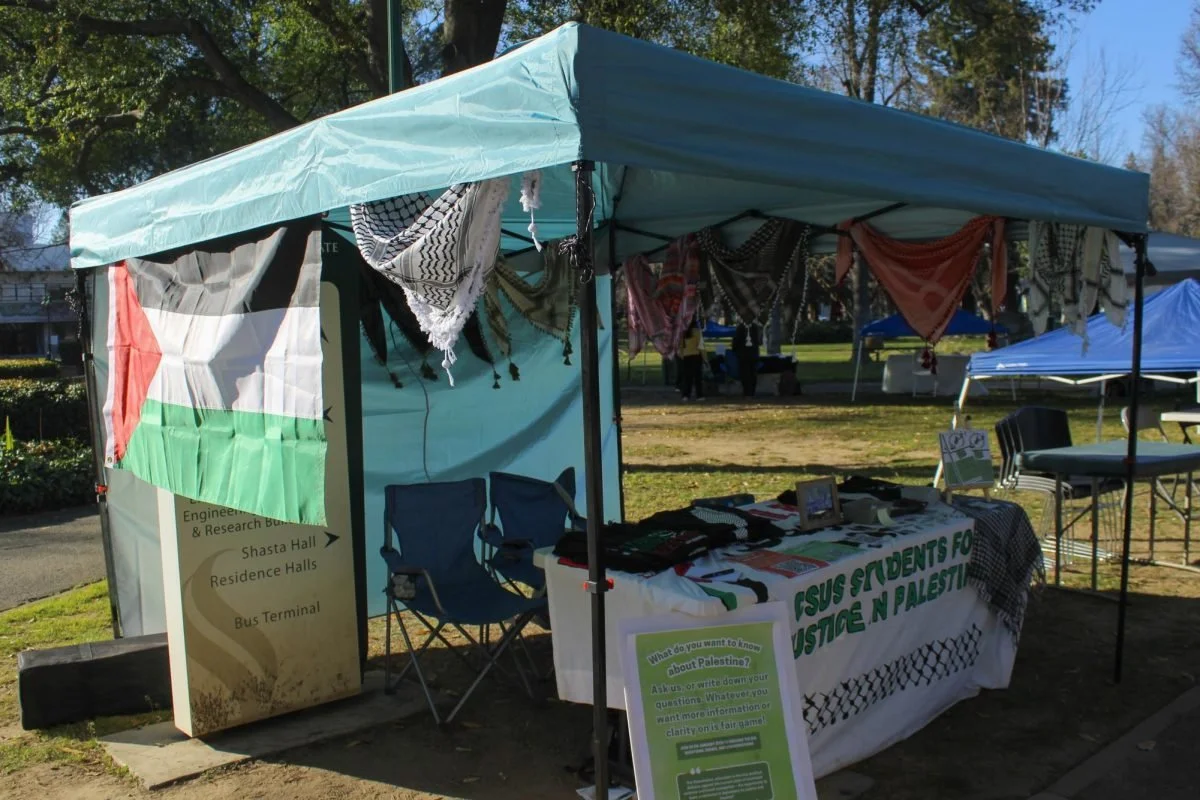
The Sacramento State chapter of Students for Justice in Palestine hosts a table for Club Days Tuesday, Jan. 28, 2025. SJP, along with other Sacramento activist groups, participated in an encampment in spring 2024 to protest the genocide in Gaza. (photo by Jocelyn Hill)
Editor’s note: Since the publishing of this story, names of certain sources have been changed for the sake of minimizing harm and protecting their safety.
Since a ceasefire in the Israel-Hamas war began on Jan. 19, students and faculty at Sacramento State have felt hopeful but still anxious for the future.
Many members of the campus community are personally invested in a secure and lasting peace in the region. Since the attacks on Oct. 7, 2023, rising rates of antisemitism, Islamophobia and anti-Arab hate have permeated college campuses across the country.
Despite the tense social climate created by the conflict, many staff and students were relieved upon hearing that an agreement had been reached to end the war.
Amal Al-Sheikh, a junior political science and journalism major, said she was thrilled when she first heard the news.
“I remember I woke up, and I saw videos of people celebrating,” Al-Sheikh said. “I was really happy. I was ecstatic.”
Al-Sheikh also said she was hesitant to feel completely at ease yet.
“I honestly couldn’t believe it because we’ve heard that there were ceasefires before,” Al-Sheikh said. “I know you kind of have to be careful not to get your hopes up and stuff, but then I saw that they kind of laid out the same agreement that they had like a few months ago.”
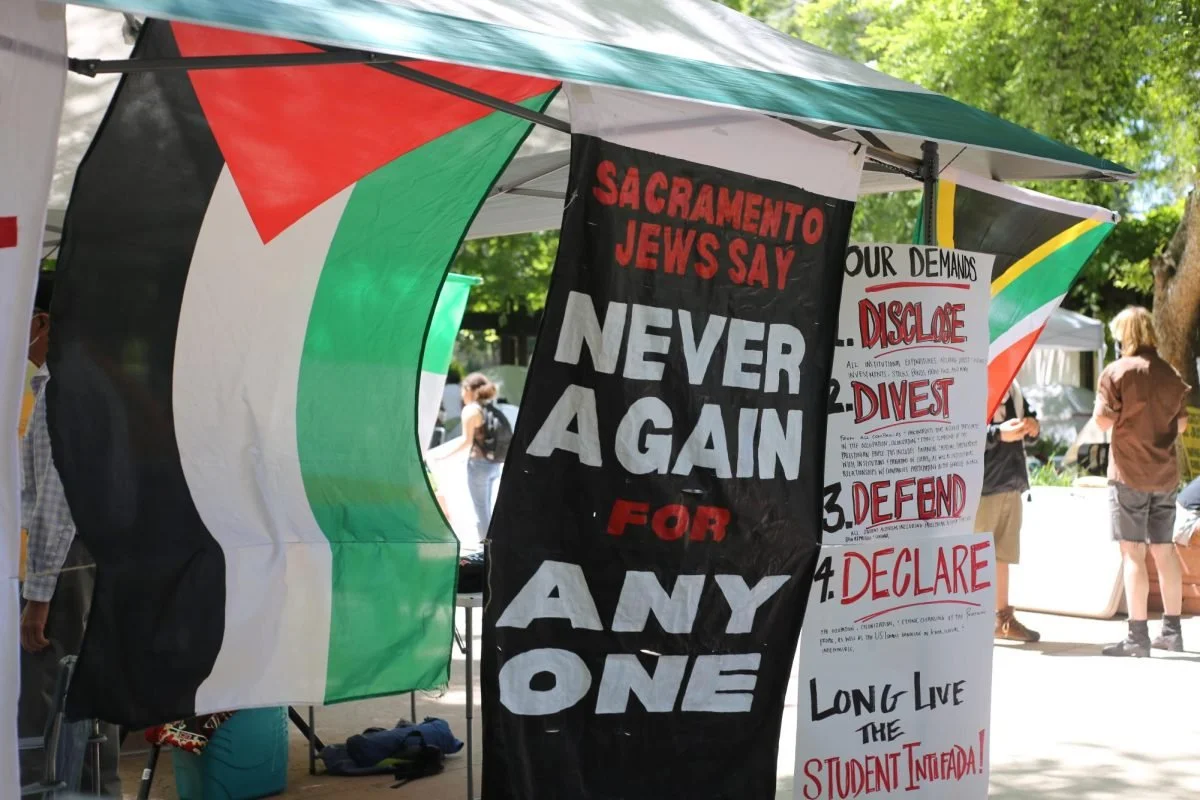
The Palestinian flag is hung alongside protest signs at the Popular University for Palestine encampment in Sac State’s library quad Tuesday, April 30, 2024. Activists from campus and the surrounding Sacramento community organized the encampment last spring to protest the war in Gaza. (photo by Alyssa Branum)
Al-Sheikh, who is Palestinian herself, said that many of her relatives have moved to Jordan following outbreaks of violence in recent decades. She said she hopes that one day conditions will be peaceful enough for her family to return. As of now, she said she is worried for the safety of one family member who lives near a settlement and has seen increasing violence from extremist settlers.
“We can’t have one place safe without having the whole place safe, because while we get a ceasefire in this one place, settler violence increases in another one in Palestine,” Al-Sheikh said.
Marwah Majeed, a senior biological science major and member of SJP, said she was more reluctant to celebrate upon hearing of the ceasefire.
“Now it’s like Gaza’s unlivable, so I don’t know how long it’s gonna take to rebuild it, how long it’s gonna take for all these refugees to come back,” Majeed said. “I’m happy this ceasefire happened, but I’m also not sure how long they will keep it.”
Harvey Stark, professor of humanities and religious studies, helped champion a resolution among Sac State’s Faculty Senate in support of a ceasefire in Gaza last spring.
Stark, whose work has been shaped by his father, a Holocaust survivor, said he also felt hopeful, but skeptical upon hearing about the ceasefire. He said he remains committed to fostering an inclusive and welcoming space for all who are affected by the conflict between Israel and Palestine.
RELATED: Day 2 of the International Conference on Genocide reflects on trauma and healing
“We’re trying to represent our students as best as we can when we see them in pain because we have Palestinian students. We have Lebanese students, as well as faculty,” Stark said. “I’m Jewish, for instance, but I’ve been very active in working towards or supporting Palestinian rights.”
Political science professor Andrew Hertzoff said he is wary to believe the promise of peace without diplomatic intervention from a third party.
“My reaction was skepticism and not a lot of optimism about it actually holding or promising much in the future,” Hertzoff said. “The thing with ceasefires is that they tend to shake as soon as there is a single act that violates them, and we’ve already seen several acts on both sides, or at least accusations.”
Despite fears of violence disrupting the ceasefire arrangement, Majeed said she has felt uplifted by the support and kindness shown by Sac State’s community, noting last April’s encampment as one notable instance.
“I loved the support at the encampment and after, too. Before, they used to not know anything about Palestine. Now, even professors in my classes talk about it,” Majeed said. “I love the community support.”
Al-Sheikh said that while a ceasefire in Gaza is a welcome feat, SJP’s work in advocating for Palestinian liberation is not over yet.
“We’re still celebrating, but we were also like, ‘Okay, this isn’t a break for us.’ We still have a lot to do,” Al-Sheikh said. “We’re happy about it, but we also want to be holding Israel and our government accountable because they are the ones who let it get this far.”
Despite doubts of a peaceful resolution, Stark said that he is hopeful for the future among activists – so long as the work does not stop.
“There’s so much work to do, you know?” Stark said. “Students, faculty, we all have a lot of work to do and I think people are trying to figure out what the next steps are in terms of campus activism.”
